


Supports mitochondrial function and metabolic processes to promote daily energy, focus and vitality.
- Supports cellular energy production
- Promotes healthy metabolic function
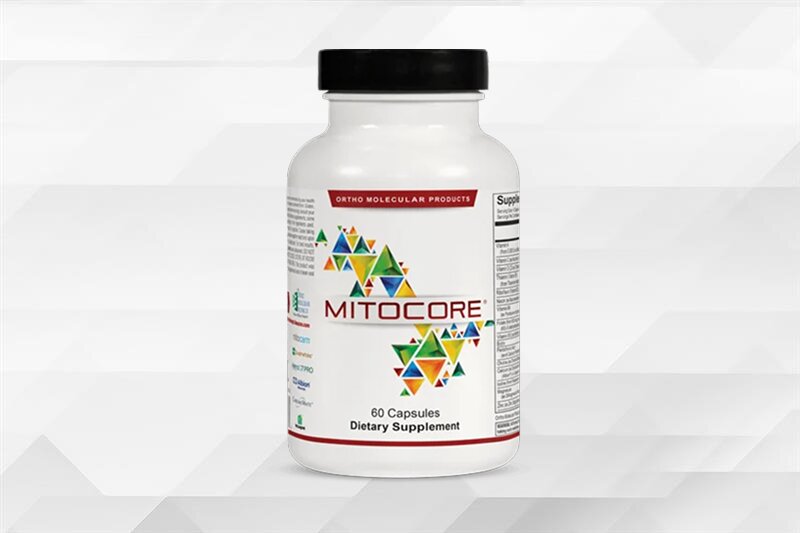
Supports heart, brain, joint, skin, and eye health while helping maintain a healthy inflammatory response.
- Supports cardiovascular health and blood sugar metabolism
- Helps maintain joint health and normal inflammatory balance

Promotes a balanced gut microbiome to support digestion, nutrient absorption, and immune function.
- Supports secretory IgA and gut immune health
- Promotes digestive comfort, bowel regularity, and nutrient absorption
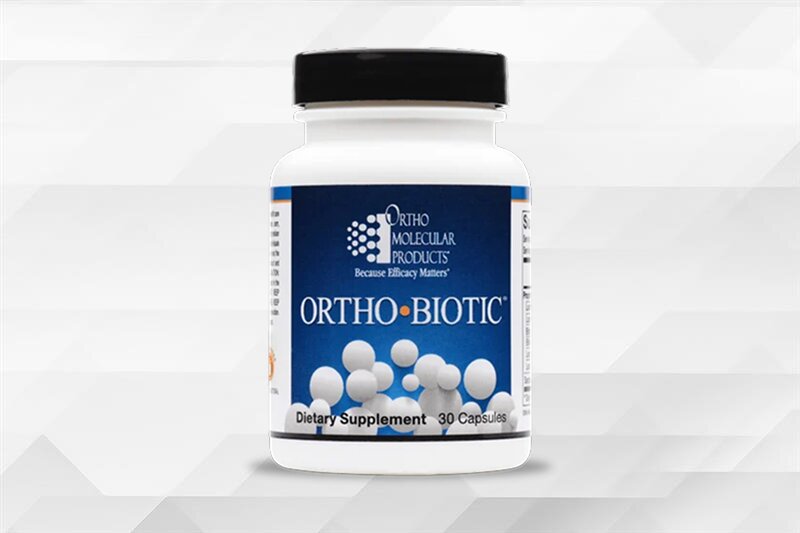
Supports mitochondrial function and metabolic processes to promote daily energy, focus and vitality.
- Supports cellular energy production
- Promotes healthy metabolic function
Supports heart, brain, joint, skin, and eye health while helping maintain a healthy inflammatory response.
- Supports cardiovascular health and blood sugar metabolism
- Helps maintain joint health and normal inflammatory balance
Promotes a balanced gut microbiome to support digestion, nutrient absorption, and immune function.
- Supports secretory IgA and gut immune health
- Promotes digestive comfort, bowel regularity, and nutrient absorption
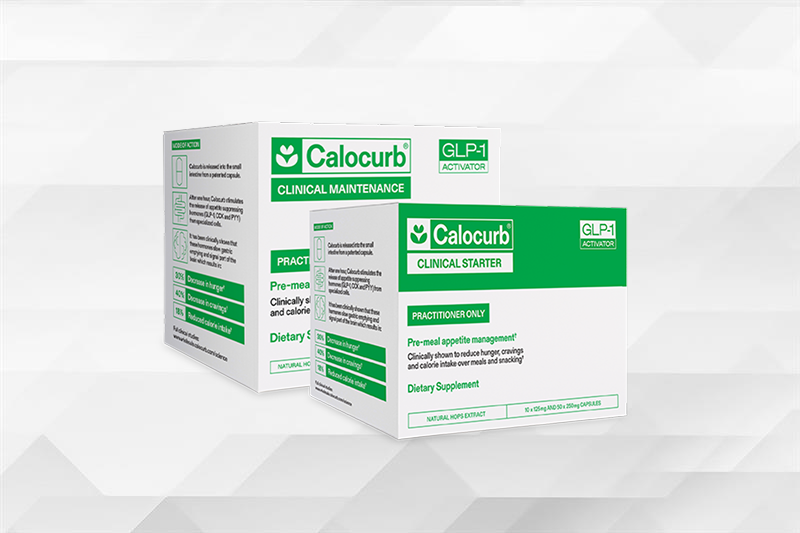
Supports healthy appetite regulation and metabolic function by promoting the body's natural satiety signals.
- Stimulates natural GLP-1, CCK, and PYY release
- Enhances adherence to intermittent fasting and time-restricted eating
Promotes a balanced gut microbiome to support digestion, nutrient absorption, and immune function.
- Delivers 11 g of fiber to support digestive health
- Supports natural GLP-1 production to help manage appetite
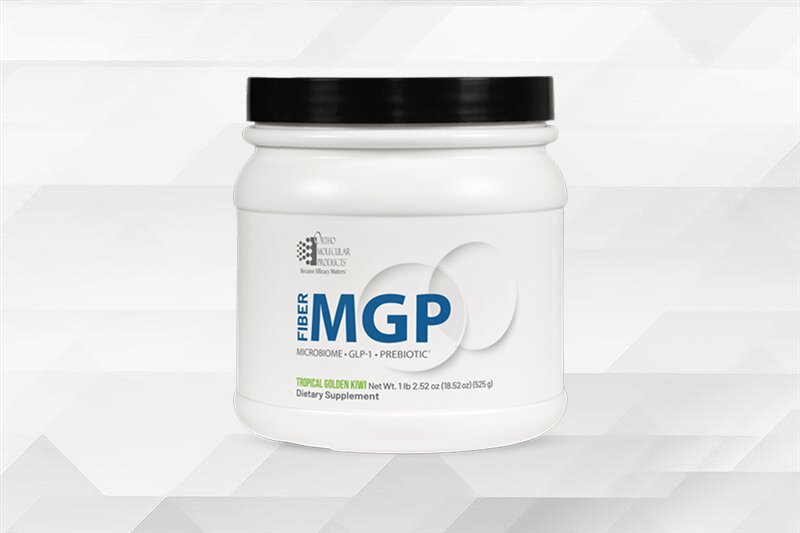
Supports healthy appetite regulation and metabolic function by promoting the body's natural satiety signals.
- Stimulates natural GLP-1, CCK, and PYY release
- Enhances adherence to intermittent fasting and time-restricted eating
Promotes a balanced gut microbiome to support digestion, nutrient absorption, and immune function.
- Delivers 11 g of fiber to support digestive health
- Supports natural GLP-1 production to help manage appetite
From evidence-based formulations and uncompromising quality standards to long-term partnerships with licensed health care practitioners, our purpose-driven approach shapes everything we do.

From evidence-based formulations and uncompromising quality standards to long-term partnerships with licensed health care practitioners, our purpose-driven approach shapes everything we do.
Our evidence-based supplements are available only through licensed health care professionals, reflecting our commitment to the medical community.

Our evidence-based supplements are available only through licensed health care professionals, reflecting our commitment to the medical community.
Our commitment to evidence-based formulation, rigorous quality standards, and practitioner partnership has earned recognition across the health care industry. These distinctions reflect our ongoing focus on scientific integrity, efficacy, and clinical trust.

Our commitment to evidence-based formulation, rigorous quality standards, and practitioner partnership has earned recognition across the health care industry. These distinctions reflect our ongoing focus on scientific integrity, efficacy, and clinical trust.
Access educational product videos, detailed product information sheets, and approved social media assets designed to support licensed health care professionals.

Access educational product videos, detailed product information sheets, and approved social media assets designed to support licensed health care professionals.
Find the right solution for ordering, patient care, and practice growth.

Find the right solution for ordering, patient care, and practice growth.
Tools and programs designed to help independent pharmacies drive front-end growth and long-term patient loyalty.

Tools and programs designed to help independent pharmacies drive front-end growth and long-term patient loyalty.
We partner exclusively with licensed health care professionals to deliver evidence-based supplements and clinical support.
We partner exclusively with licensed health care professionals to deliver evidence-based supplements and clinical support.

Saccharomyces Boulardii: The Probiotic Yeast Explained
TL;DR: Saccharomyces boulardii is a probiotic yeast that supports the gut much like a healthy resident flora. It has been tested in dozens of randomized controlled trials involving thousands of people. Lab and animal studies show how it works: it supports secretory IgA, the gut's first-line antibody, and helps gut-lining cells keep their tight junctions intact. At Ortho, it is one of the probiotics practitioners use to balance gastrointestinal flora.
This page explains what S. boulardii is, what research supports, how it works alongside your own gut bacteria, and how practitioners use it. You can browse our full range of probiotics here.
What Saccharomyces boulardii is
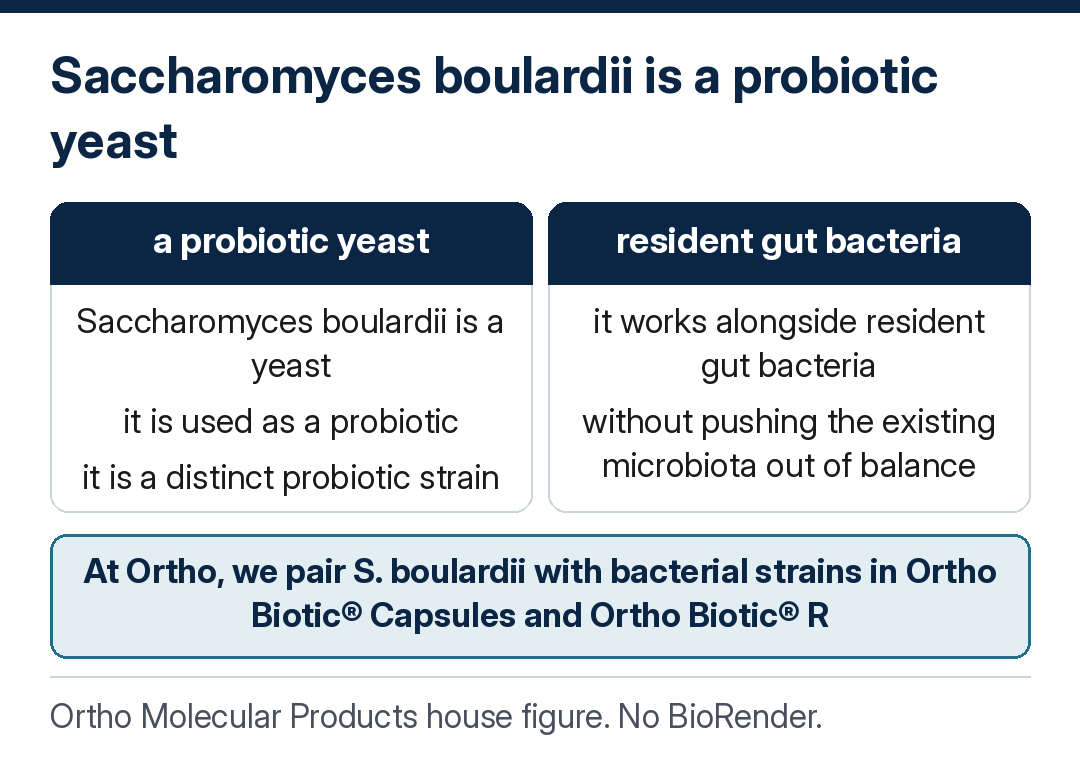
Saccharomyces boulardii is a yeast, not a bacterium, and it is used as a probiotic. Scientists classify it as a subtype of Saccharomyces cerevisiae, the species that also includes the brewer's and baker's yeast used in food, but it is a distinct probiotic strain with its own research record. A review from UCLA describes S. boulardii as mediating "responses resembling the protective effects of the normal healthy gut flora."
Probiotics are live microorganisms that, in the right amounts, provide a health benefit, and their benefits belong to specific strains. That is why researchers and practitioners talk about S. boulardii as a strain-level probiotic.
A probiotic with a deep research record
S. boulardii has been tested in dozens of randomized controlled trials involving thousands of people. Two pooled analyses show the scale:
- A US systematic review pooled 31 placebo-controlled study arms in 27 trials, covering 5,029 study patients.
- A meta-analysis pooled 21 randomized controlled trials with 4,780 participants.
Those trials looked at several specific uses. Taken together, they make S. boulardii a well-researched probiotic for practitioners who want a strain with a long human track record.
How S. boulardii works alongside your gut bacteria
A probiotic should support the community already living in your gut. S. boulardii fits that description. In healthy people, it works alongside resident gut bacteria without pushing the existing microbiota out of balance.
Saccharomyces boulardii is a probiotic yeast. Its role differs from that of bacterial probiotics, and the expected benefit should be matched to the specific strain and formulation.
How it works: what lab and animal studies show
These are mechanism findings from lab and animal research. They help explain how S. boulardii supports the gut.
- Secretory IgA. In an animal study, rats given S. boulardii had 56.9% more secretory IgA in their intestinal fluid than controls. Secretory IgA is an antibody that helps defend the gut lining.
- Tight junctions. In lab studies, S. boulardii helped human gut-lining cells keep their tight junctions intact when the cells were challenged by unwanted bacteria. Tight junctions are the seals between neighboring lining cells.
These lab and animal findings line up with the uses on our product page: "Balances Gastrointestinal Flora" and "Supports Gastrointestinal Barrier Function and Integrity."
Reading S. boulardii research
S. boulardii trials studied specific uses in specific groups of people, and the lab work on secretory IgA and tight junctions comes from animal and cell studies. That is normal for a natural probiotic, and it is why practitioners match a probiotic to a goal and look at how each study was run. The checklist practitioners use for any probiotic, including strain, amount and storage, applies here too.
S. boulardii also appears in research on the gut barrier, alongside nutrients such as L-glutamine and zinc.
How S. boulardii fits with other probiotics
At Ortho, we pair S. boulardii with bacterial strains in Ortho Biotic® Capsules and Ortho Biotic® R. The Capsules label lists six bacterial strains alongside S. boulardii, R uses a different set of probiotic strains, and we also offer S. boulardii on its own. That gives practitioners room to use a single probiotic yeast, a multi-strain formula, or a rotation between formulas.
Practitioners choose a probiotic by matching the strain to the goal, then checking the formulation, the amount studied, and the maker's quality control and shelf life. For any probiotic, including a probiotic yeast, federal guidance says to look for the number of live organisms (CFU) at the end of shelf life, not when the product was made, and to check the label for storage conditions.
Who should check first
S. boulardii is well tolerated by most healthy adults. People who are seriously ill, hospitalized or immunocompromised should talk with their practitioner first, because published safety reports have involved people in intensive care or receiving intensive hospital care. For questions about an Ortho product and a medication you take, contact our customer service team at 1-800-332-2351 or contactus@ompimail.com.
What practitioners use
- Saccharomyces boulardii. Our formula "includes a probiotic yeast that helps support immune function and balance gastrointestinal flora." Its product page lists "Balances Gastrointestinal Flora" and "Supports Gastrointestinal Barrier Function and Integrity."
- Ortho Biotic® Capsules. Our multi-strain probiotic pairs six labeled bacterial strains with S. boulardii.
- Ortho Biotic® R. A reserve formula that pairs S. boulardii with its own distinct set of probiotic strains, which practitioners can use for a rotational approach to probiotics.
Compare our probiotics on the Ortho Biotic® family page.
How to get Ortho products
Every Ortho product is available only through licensed practitioners.
- Patients: ask your practitioner whether they use Clinical Care Path™.
- Licensed practitioners: open a practitioner account. Practitioner pricing: log in.
- Product-fit or medication questions: contact our customer service team at 1-800-332-2351 or contactus@ompimail.com, 7am to 6pm CST.
Frequently asked questions
What is Saccharomyces boulardii? Saccharomyces boulardii is a probiotic yeast. It supports the gut much like a healthy resident flora, and it has been tested in dozens of randomized controlled trials involving thousands of people.
Is Saccharomyces boulardii the same as baker's yeast? No. Scientists classify it as a subtype of Saccharomyces cerevisiae, the species that includes brewer's and baker's yeast, but it is a distinct probiotic strain with its own research record.
How does S. boulardii work? Lab and animal studies show it supports secretory IgA, an antibody that helps defend the gut lining, and helps gut-lining cells keep their tight junctions intact. In healthy people, it works alongside resident gut bacteria without pushing the microbiota out of balance.
Is S. boulardii safe? It is well tolerated by most healthy adults. People who are seriously ill, hospitalized or immunocompromised should talk with their practitioner first.
What should I look for in an S. boulardii supplement? Practitioners match the strain to the goal, then check the formulation, the amount studied, and the maker's quality control and shelf life. Federal guidance says to look for the number of live organisms (CFU) at the end of shelf life, not when the product was made, and to check the label for storage conditions.
Next step
Practitioners: open an Ortho account. Patients: ask your practitioner whether a probiotic yeast fits your gut health plan.
These statements have not been evaluated by the Food and Drug Administration. These products are not intended to diagnose, treat, cure or prevent any disease.
Sources
- Kelesidis T, Pothoulakis C. Ther Adv Gastroenterol 2012;5(2):111-25. PMID 22423260. doi:10.1177/1756283X11428502
- Enache-Angoulvant A, Hennequin C. Clin Infect Dis 2005;41(11):1559-68. PMID 16267727. doi:10.1086/497832
- McFarland LV. World J Gastroenterol 2010;16(18):2202-22. PMID 20458757. doi:10.3748/wjg.v16.i18.2202
- Szajewska H, Kołodziej M. Aliment Pharmacol Ther 2015;42(7):793-801. PMID 26216624. doi:10.1111/apt.13344
- Kabbani TA, Pallav K, Dowd SE, et al. Gut Microbes 2017;8(1):17-32. PMID 27973989. doi:10.1080/19490976.2016.1267890
- Buts JP, Bernasconi P, Vaerman JP, Dive C. Dig Dis Sci 1990;35(2):251-6. PMID 2302983. doi:10.1007/BF01536771
- Czerucka D, Dahan S, Mograbi B, Rossi B, Rampal P. Infect Immun 2000;68(10):5998-6004. PMID 10992512. doi:10.1128/IAI.68.10.5998-6004.2000
- Terciolo C, Dapoigny M, Andre F. Clin Exp Gastroenterol 2019;12:67-82. PMID 30804678. doi:10.2147/CEG.S181590
- NIH Office of Dietary Supplements. Probiotics: Fact Sheet for Health Professionals (updated March 25, 2025). https://ods.od.nih.gov/factsheets/Probiotics-HealthProfessional/
- Hill C, Guarner F, Reid G, et al. Nat Rev Gastroenterol Hepatol 2014;11(8):506-14. PMID 24912386. doi:10.1038/nrgastro.2014.66
- Sniffen JC, McFarland LV, Evans CT, Goldstein EJC. PLoS One 2018;13(12):e0209205. PMID 30586435. doi:10.1371/journal.pone.0209205
- Ortho Molecular Products product pages: Saccharomyces boulardii, Ortho Biotic® Capsules, Ortho Biotic® R.


These statements have not been evaluated by the Food and Drug Administration. These products are not intended to diagnose, treat, cure or prevent any disease.
