


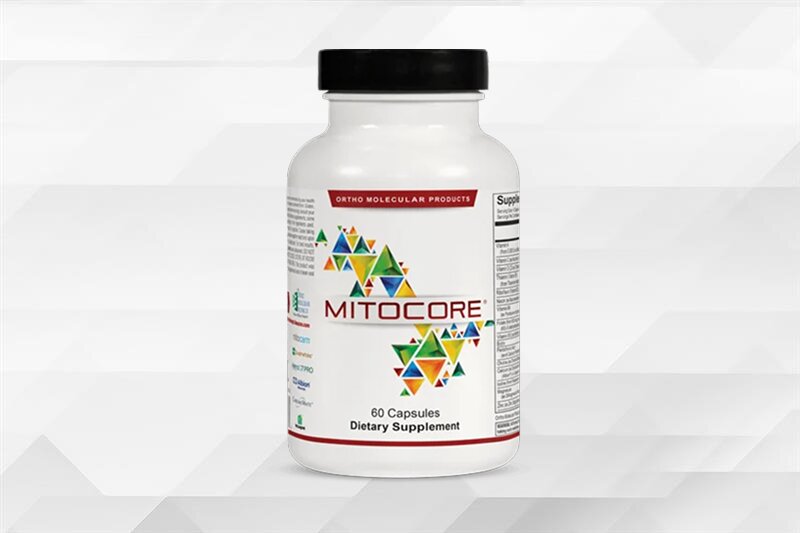
Supports mitochondrial function and metabolic processes to promote daily energy, focus and vitality.
- Supports cellular energy production
- Promotes healthy metabolic function
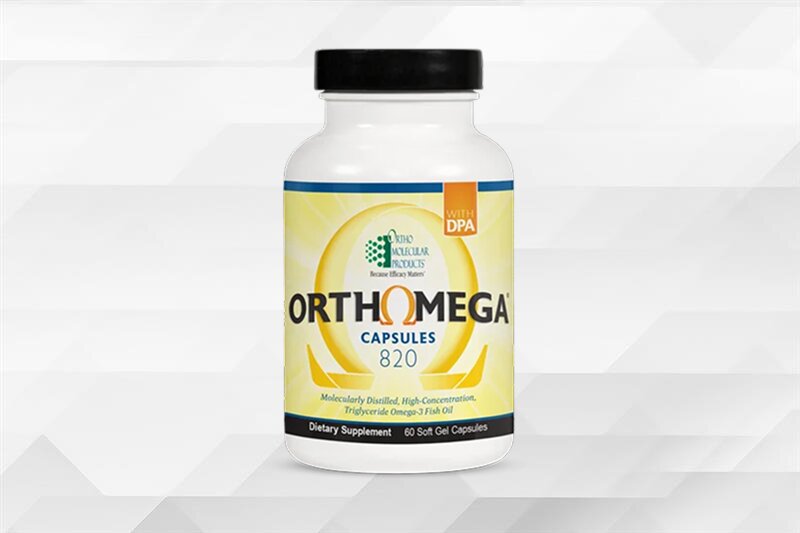
Supports heart, brain, joint, skin, and eye health while helping maintain a healthy inflammatory response.
- Supports cardiovascular health and blood sugar metabolism
- Helps maintain joint health and normal inflammatory balance
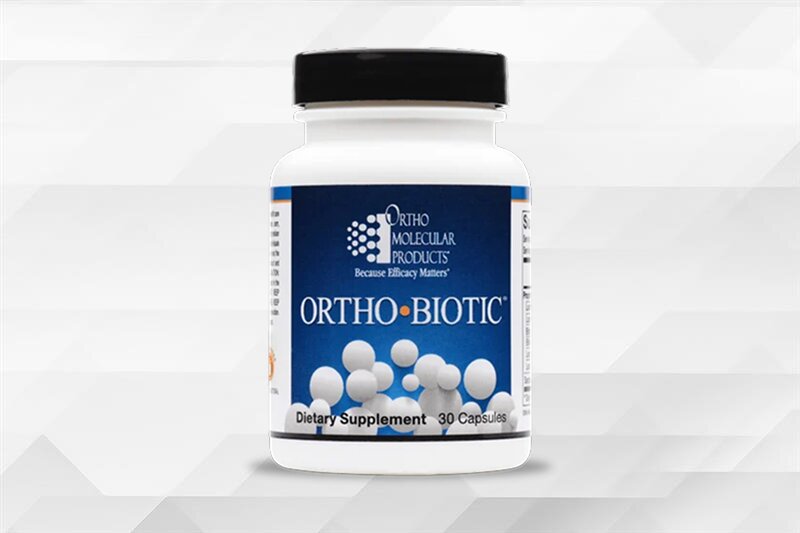
Promotes a balanced gut microbiome to support digestion, nutrient absorption, and immune function.
- Supports secretory IgA and gut immune health
- Promotes digestive comfort, bowel regularity, and nutrient absorption
Supports mitochondrial function and metabolic processes to promote daily energy, focus and vitality.
- Supports cellular energy production
- Promotes healthy metabolic function
Supports heart, brain, joint, skin, and eye health while helping maintain a healthy inflammatory response.
- Supports cardiovascular health and blood sugar metabolism
- Helps maintain joint health and normal inflammatory balance
Promotes a balanced gut microbiome to support digestion, nutrient absorption, and immune function.
- Supports secretory IgA and gut immune health
- Promotes digestive comfort, bowel regularity, and nutrient absorption
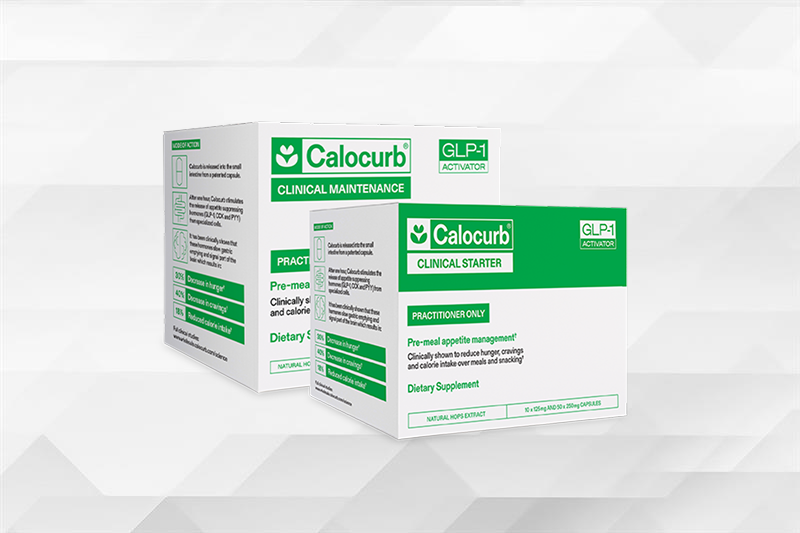
Supports healthy appetite regulation and metabolic function by promoting the body's natural satiety signals.
- Stimulates natural GLP-1, CCK, and PYY release
- Enhances adherence to intermittent fasting and time-restricted eating
Promotes a balanced gut microbiome to support digestion, nutrient absorption, and immune function.
- Delivers 11 g of fiber to support digestive health
- Supports natural GLP-1 production to help manage appetite
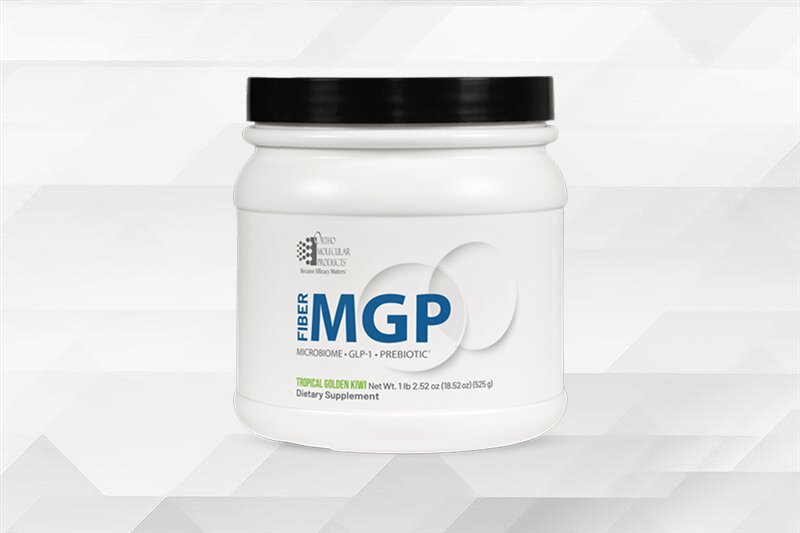
Supports healthy appetite regulation and metabolic function by promoting the body's natural satiety signals.
- Stimulates natural GLP-1, CCK, and PYY release
- Enhances adherence to intermittent fasting and time-restricted eating
Promotes a balanced gut microbiome to support digestion, nutrient absorption, and immune function.
- Delivers 11 g of fiber to support digestive health
- Supports natural GLP-1 production to help manage appetite
From evidence-based formulations and uncompromising quality standards to long-term partnerships with licensed health care practitioners, our purpose-driven approach shapes everything we do.

From evidence-based formulations and uncompromising quality standards to long-term partnerships with licensed health care practitioners, our purpose-driven approach shapes everything we do.
Our evidence-based supplements are available only through licensed health care professionals, reflecting our commitment to the medical community.

Our evidence-based supplements are available only through licensed health care professionals, reflecting our commitment to the medical community.
Our commitment to evidence-based formulation, rigorous quality standards, and practitioner partnership has earned recognition across the health care industry. These distinctions reflect our ongoing focus on scientific integrity, efficacy, and clinical trust.

Our commitment to evidence-based formulation, rigorous quality standards, and practitioner partnership has earned recognition across the health care industry. These distinctions reflect our ongoing focus on scientific integrity, efficacy, and clinical trust.
Access educational product videos, detailed product information sheets, and approved social media assets designed to support licensed health care professionals.
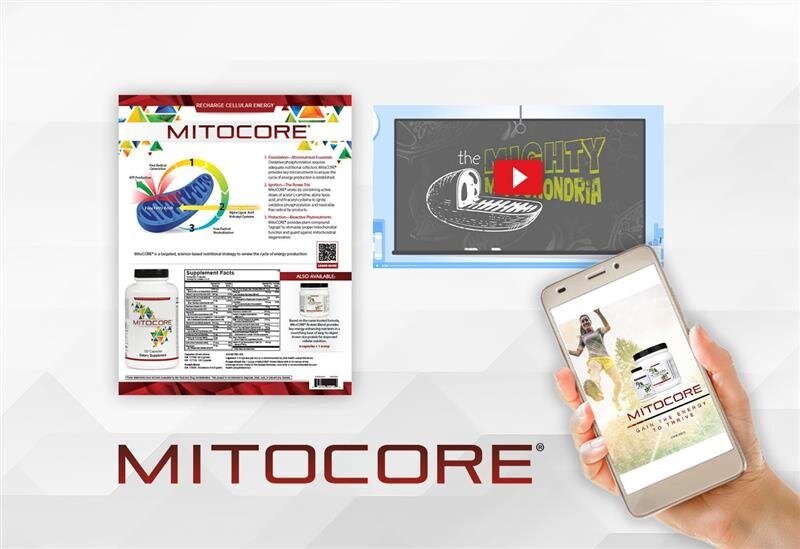
Access educational product videos, detailed product information sheets, and approved social media assets designed to support licensed health care professionals.
Find the right solution for ordering, patient care, and practice growth.
Find the right solution for ordering, patient care, and practice growth.
Tools and programs designed to help independent pharmacies drive front-end growth and long-term patient loyalty.

Tools and programs designed to help independent pharmacies drive front-end growth and long-term patient loyalty.
We partner exclusively with licensed health care professionals to deliver evidence-based supplements and clinical support.
We partner exclusively with licensed health care professionals to deliver evidence-based supplements and clinical support.

How to Read a Certificate of Analysis (COA) for a Supplement
A certificate of analysis is a lab summary for one production lot: it lists each test that was run, the specification the lot had to meet, the actual result, and the test method, and it is signed by quality control. To read one, match the lot number to your bottle first, then check that every result falls inside its specification and that the tests cover identity, strength, and contaminants.
At Ortho Molecular Products, we provide lot COAs to practitioners on request, and we think every practitioner should feel confident reading one. This page is for practitioners who request COAs for products they stock and for patients who received one and want to know what they are looking at. It walks through each part of a typical supplement COA, shows a five-line check you can run in a minute, and covers what to look for. The supplement quality guide puts the COA in context with facility audits and cGMP.
Why the COA is the most useful single document
Facility certifications and brand statements describe systems. A COA describes the product. It is the closest you can get to seeing what is inside the specific bottle on your shelf without sending it to a lab yourself.
Federal rules require manufacturers to set specifications for each finished batch and to determine whether those specifications are met (21 CFR 111.75), and to keep the records (21 CFR 111.605). A COA is how that data gets summarized for an outside reader. A company running a sound system already has it and can share it readily.
The parts of a COA
Header
Company name, product name, dosage form, lot or batch number, manufacture date, and expiration or retest date. The lot number is the most important line on the page.
Specifications
The target or acceptable range for each test. For a vitamin, a potency spec might be expressed as a percent of label claim. For contaminants, specs are upper limits.
Results
The measured value for this lot, next to its spec. Each line should say pass, conform, or meets, or show a value you can compare to the spec yourself.
Methods
How each test was done. Common references include USP chapters for microbial testing and elemental impurities, and techniques such as HPLC (high-performance liquid chromatography) for potency, ICP-MS for heavy metals, and FTIR or HPTLC for botanical identity. You can skip the chemistry. Just look for a named, recognized method.
Sign-off
Name or signature of the quality control reviewer and the release date. The sign-off is what makes the COA a final release record.
The five-line check
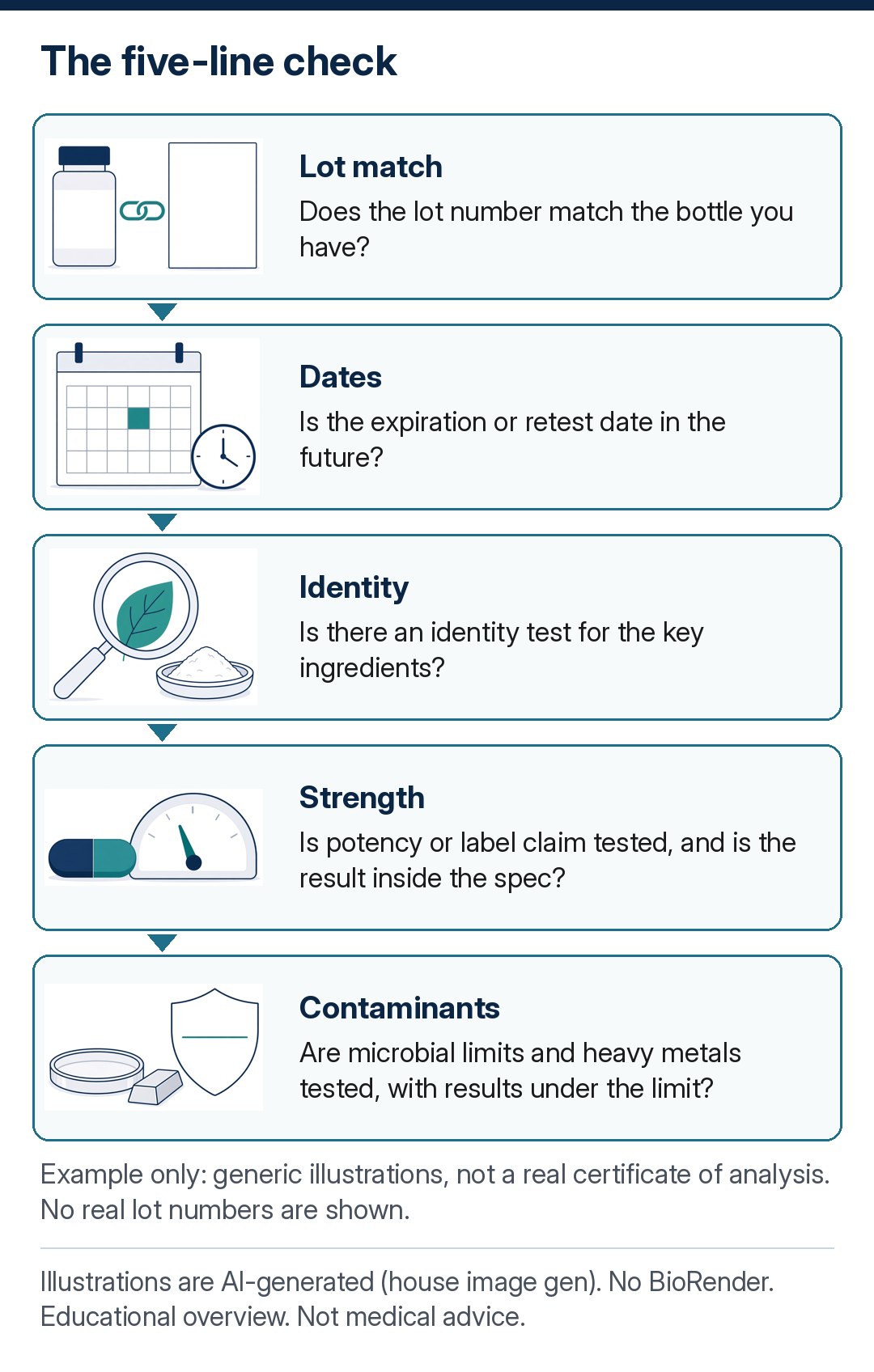
Run this every time a COA arrives:
- Lot match. Does the lot number match the bottle you have? If not, ask for the right one.
- Dates. Is the expiration or retest date in the future?
- Identity. Is there an identity test for the key ingredients?
- Strength. Is potency or label claim tested, and is the result inside the spec?
- Contaminants. Are microbial limits and heavy metals tested, with results under the limit?
When all five pass, the COA has done its job. If a line is missing, ask the manufacturer. Some tests are run on the raw materials before the finished lot is made, which is a legitimate approach, and a well-run company can explain where each test sits.
Reading the tests that matter most
Identity. Confirms the ingredient is what it claims to be. Federal rules require at least one identity test for each dietary ingredient before use. On a finished-product COA, identity may be reported for the key actives.
Potency or assay. Confirms how much of each active is present. Results are often reported as a percent of label claim or in units per serving. Some ingredients degrade over shelf life, so manufacturers may put more in at the start. A result above 100% can be fine. Check it against the spec.
Microbial testing. Total aerobic count, yeast and mold, and specific pathogens such as E. coli and Salmonella. Pathogen results should read absent or negative. Probiotics will show high counts of the intended organisms, which is expected. Contaminant counts are listed on their own lines.
Heavy metals. Usually lead, arsenic, cadmium, and mercury, reported in parts per million or micrograms per serving against a limit.
Other. Depending on the product: residual solvents for extracts, oxidation values for oils, disintegration for tablets, allergen statements.
How label claim is protected through expiration
A COA shows a lot at release. Practitioners also want to know the product will still meet its label at the end of its shelf life. That is the job of stability testing.
At Ortho, stability testing is built into every new formula. We assay its ingredients over time for degradation, so the formula still meets its label claim at expiration (Ortho Molecular Products corporate brochure). How a brand confirms label claim at expiration is a good question to ask of any line you stock.
A decision framework for practitioners
- Request a COA for each product before you stock it, using a real lot number.
- Keep the COA on file with the lot number and the date received. If a patient or a recall question comes up, you have the record.
- Re-request when lots change for products you dispense in volume.
- Use response time as a signal. A company with an organized system can usually turn a request around quickly.
The cGMP rule is the system behind every COA. For how it works, see what cGMP means for supplements.
What a complete COA includes
A complete, useful COA has all of these:
- A lot number that matches your bottle.
- A specification next to every result.
- Identity, potency, and contaminant testing together.
- A named method for each test.
- A quality control signature and release date.
- Measured values for each test.
Contract lab reports and certifier listings are related but different documents. For how they fit together, see third party tested supplements.
How to request a COA from Ortho Molecular Products
We provide certificates of analysis to practitioners on request. Send us:
- The product name, for example Ubiquinol.
- The lot number printed on the bottle.
Behind each COA is product testing through in-house and outside laboratories, depending on the product, for purity, strength, and composition (The Ortho Difference), in a Stevens Point, Wisconsin plant that appears on NSF's 455-2 GMP facility list (NSF listing). The COA is how you see the lot results behind those statements.
Frequently asked questions
What is a COA for supplements? A certificate of analysis is a lab summary for one lot. It lists tests, specifications, results, and methods, and is signed by quality control.
Can I get a COA for any supplement? You can ask any manufacturer. Many professional brands provide them on request. How quickly and completely they respond tells you about their systems.
What should a supplement COA include? At minimum: lot number, identity, potency for key actives, microbial limits, heavy metals, methods, and a QC sign-off.
Why is potency sometimes above 100%? Some ingredients lose strength over time, so manufacturers may add more at production to stay at or above label claim through the expiration date. Check the result against the spec on the COA.
Is a COA from the brand trustworthy? It is a record from the brand's quality system, signed by its quality control team. Pair it with an independent signal, such as a facility GMP listing you looked up, for an outside check.
Do patients need to read COAs? Most rely on their practitioner for this. A COA is especially helpful for patients with allergies or sensitivities, or anyone who wants to see the proof behind a product their practitioner recommended.
Next step
Practitioners can create a practitioner account with Ortho to work with the catalog directly.
Up one level: the full guide to supplement quality.


These statements have not been evaluated by the Food and Drug Administration. These products are not intended to diagnose, treat, cure or prevent any disease.
